The Jerome Avenue “El”
-
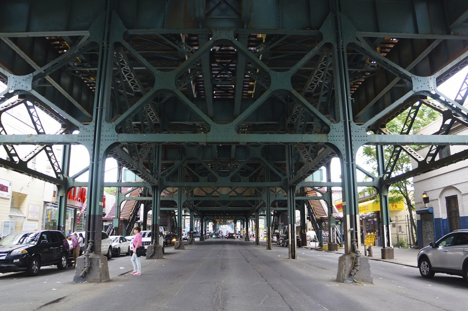
When I was a kid, we often visited my mother’s parents in New York City, about a four-hour drive from our home in Massachusetts. John and Iskuhe Gadarian lived in an apartment building on 179th Street in the Bronx, a block from the Jerome Avenue elevated subway, not far from where the picture accompanying this post was taken.
We usually arrived at my grandparents’ apartment in the early afternoon. Shortly after we got there, the same thing always happened. There was a roaring noise, louder than thunder, and the whole building would shake. For a second or two, it would feel like the end of the world. My autonomic nervous system went almost instantaneously into full emergency mode. Then I would realize that it was only the subway and just as quickly, I would calm down.
By the time evening came, the noise from the “El” no longer bothered me. On Saturday nights in New York, a TV station showed old black and white horror movies continuously until dawn, and I would watch as many of them as I could before nodding off. Then I would sleep soundly all through the night, even though the subway never stopped running.
So it took me less than 12 hours to adjust to an experience that felt at first like the end of the world. Let's think about how this example connects to the resiliency of the human race.
-
We can adjust to things that might have seemed too frightening to handle just a second ago, even finding ways to thrive and experience happiness amid all manner of adverse circumstances. As you are reading this, there are people all over the world who have successfully adapted to living in places you might consider too hot, too cold, too crowded or too dangerous.
Most people probably wouldn’t choose to live so close to the El. I’m willing to bet that if we tried to rent my grandparents’ apartment to a random sample of 100 people, if the El went by during their showing, at least 90% would turn it down. I also suspect that the sheer volume of the train might even meet today’s criteria for noise pollution, carrying with it a risk of hearing loss. Nevertheless, my grandparents, not only tolerated the noisy apartment, but they moved back to that building after living in a quieter area for several years. When my grandmother used to sit on the front porch of our single-family home in Massachusetts, she would often complain that the neighborhood was too quiet.
-
We’ve all heard the adage, “Necessity is the mother of invention” so many times that it may have ceased to have much meaning for many of us, but survival pressures and challenges have directly resulted in the development of ever-more-sophisticated coping strategies, including new tools, medical advances and technological innovations throughout history. Human adaptability has given rise to the many incredible acts of endurance, ingenuity, creativity, heroism and sacrifice that inspire us.
-
I’ve watched a number of TV shows that show people attempting to survive in some of the least hospitable places on earth. It’s striking how many of the participants, even those highly skilled in hunting and foraging, end up experiencing the debilitating effects of starvation and weight loss.
Watching people with all kinds of outdoor skills fail to secure enough food makes one wonder: How on earth did our primitive ancestors even survive? It turns out that we are just one of many species in the animal kingdom that demonstrate the ability to find novel solutions to survival problems. Moreover, as the oldest examples of cave art show us, early on our forebears showed the capacity for abstract thought and visualization, both of which contributed to the development of new survival skills.
Sensory adaptations enabled us to tolerate a wide range of environments, screen out distractions, and focus on solving the most pressing problems - e.g., shelter, food and water.
-
Disabling your alarm system
Your nervous system is designed to put you into instant fight-or-flight mode whenever you perceive danger so you can quickly take protective actions. In fact, some psychologists believe that we may be pre-wired to avoid the prototypical dangers that threatened our survival in pre-historic times (e.g., heights, water, dangerous animals, etc.).
Adaptation may involve partially disabling your instinctual responses to warning signs. It took less than a day for me to get used to loud sounds and tremors that might have signaled danger, to the point where they did not disrupt my sleep. What if an actual emergency or disaster had created loud noise and vibrations like the El in the middle of the night? I wonder if I would have been slow to awaken, thereby creating greater risk of injuries to myself and my family.
-
There was a time in the US when people smoked just about everywhere. Most people learned to tolerate second-hand smoke, only to discover later that doing so substantially increased their health risks, even if they didn’t use tobacco products. Many of us who lived with second-hand smoke now find it intolerable and wonder how we ever adjusted to it.
“Stockholm Syndrome” is another good example of how adaptation can distort our perceptions and lay the groundwork for further victimization. It refers to the fact that hostages and abuse victims may develop attachments to their captors or abusers, despite having been mistreated or even tortured by them.
-
People use the tools at hand to cope with adversity. For many of us, especially teens and young adults, those tools can include drugs, alcohol and sex, but coping strategies can be much more complex than simply drinking or getting high. We may learn how to tell when an intoxicated parent is about to turn mean, how to placate that parent so that a beating doesn’t follow, and how to make excuses for abusive behavior when we can’t prevent it (e.g., “She really loves me underneath it all”, “I probably had it coming”, and so on). We may find ourselves using the same strategies in adulthood to cope with a partner with an anger problem, without realizing that we have other options besides just learning to live with it.
Coping strategies that we develop in response to traumatic events in childhood can persist into adulthood, even if we no longer face the same dangers in our daily lives. For adult survivors of adverse childhood experiences, “traumatic avoidance learning” can lead to behaviors that can be resistant to change, even when they result in negative consequences. But I have found that once people understand how the underlying mechanisms work, they can start to learn better ways of coping with life’s stressors.
-
We know humans adapt to all kinds of stress and misfortune, but what happens to us when good things come our way? Can we get used to riches, beauty, fame and even being in love, to the point that they no longer give us a natural high? Unfortunately, the answer is yes. In a wonderful book called The How of Happiness, Sonja Lyubomirsky cites an extensive body of research indicating that when good things happen to us, eventually the magic wears off, and we return to the baseline level of happiness (or unhappiness) we had before. This process is called “hedonic adaptation” and shows that indeed, parties weren’t built to last.
Fortunately, Dr. Lyubomirsky has identified a number of strategies, such as the practice of gratitude, that can help us improve our moods, increase optimism and strengthen our relationships. She’s not simply making extravagant promises, because her recommendations are based on sound behavioral research. Please check out her book - you’ll learn a lot, as I did.
-
What’s your personal story of adaptation? Make a list of the stressors or difficult circumstances that you learned to tolerate and overcome during the course of your life. What does that list say about you, your skills, values, and other personal qualities? Can any of those skills or lessons help you overcome difficulties in your life today?
Now let’s look at the flip side. Did you ever find yourself learning to tolerate stressors or other adverse experiences without realizing that your were being harmed, or that you had other choices available to you? Are there any similar situations happening in your life today?
Are you experiencing a “hedonic treadmill” in one or more parts of your life, needing that next new car, new house or new romance to feel more fully alive? Are there other, non-materialistic ways to bring a deeper level of satisfaction or contentment into your day to day life (e.g., learning new skills, exploring spiritual practices, connecting with friends and loved ones, etc.) ? If so, how do you build a lifestyle that allows room for more of those experiences?
Does this blog post bring to mind any thoughts that would like to share with our audience? If so, please be sure to leave a comment below.